
A natural active ingredient is an ingredient of plant, mineral, or marine origin that has a real effect on the skin or hair. Unlike an isolated synthetic molecule, a natural active ingredient is often multifunctional: it acts on several levels at once because it naturally contains several compounds. The challenge is knowing what each one really does. This guide reviews seven natural active ingredients, from argan oil to black soap, explaining the origin, composition, documented benefits, and proper use of each. Knowing these active ingredients well allows you to choose your skincare products with confidence, rather than relying solely on the promises on a package. Here is an overview of the ingredients we detail below.
| Active Ingredient | Origin | Main Property | Ideal For |
|---|---|---|---|
| Argan oil | Argan tree, Morocco | Nourishes, repairs the barrier, antioxidant | Dry skin, hair |
| Prickly pear | Opuntia cactus | Antioxidant, suppleness | Dry and mature skin |
| Ghassoul | Atlas clay, Morocco | Purifies, absorbs sebum | Oily, combination skin, hair |
| White lily | Lily flower | Complexion radiance, soothing | Dull complexion, sensitive skin |
| Caffeine | Coffee bean | Reduces the appearance of tired eyes | Eye contour, puffiness, dark circles |
| Hyaluronic acid | Natural skin molecule | Deep hydration | All skin types, dehydrated skin |
| Black soap | Black olive paste, Morocco | Exfoliates, prepares the skin | Body ritual, exfoliation |
Natural, organic, and of natural origin: what are the differences?
These terms are not synonymous. A natural active ingredient comes directly from a plant, mineral, or marine source without extensive processing. An ingredient of natural origin starts as a natural substance but may be processed, for example through fermentation. An organic active ingredient comes from certified organic farming. Finally, some molecules are called naturally identical because they are reproduced in the laboratory to be identical to their natural versions. None of these terms alone indicates that a product is better or better tolerated: what matters is the overall formula and its quality.
Argan oil: Morocco's liquid gold
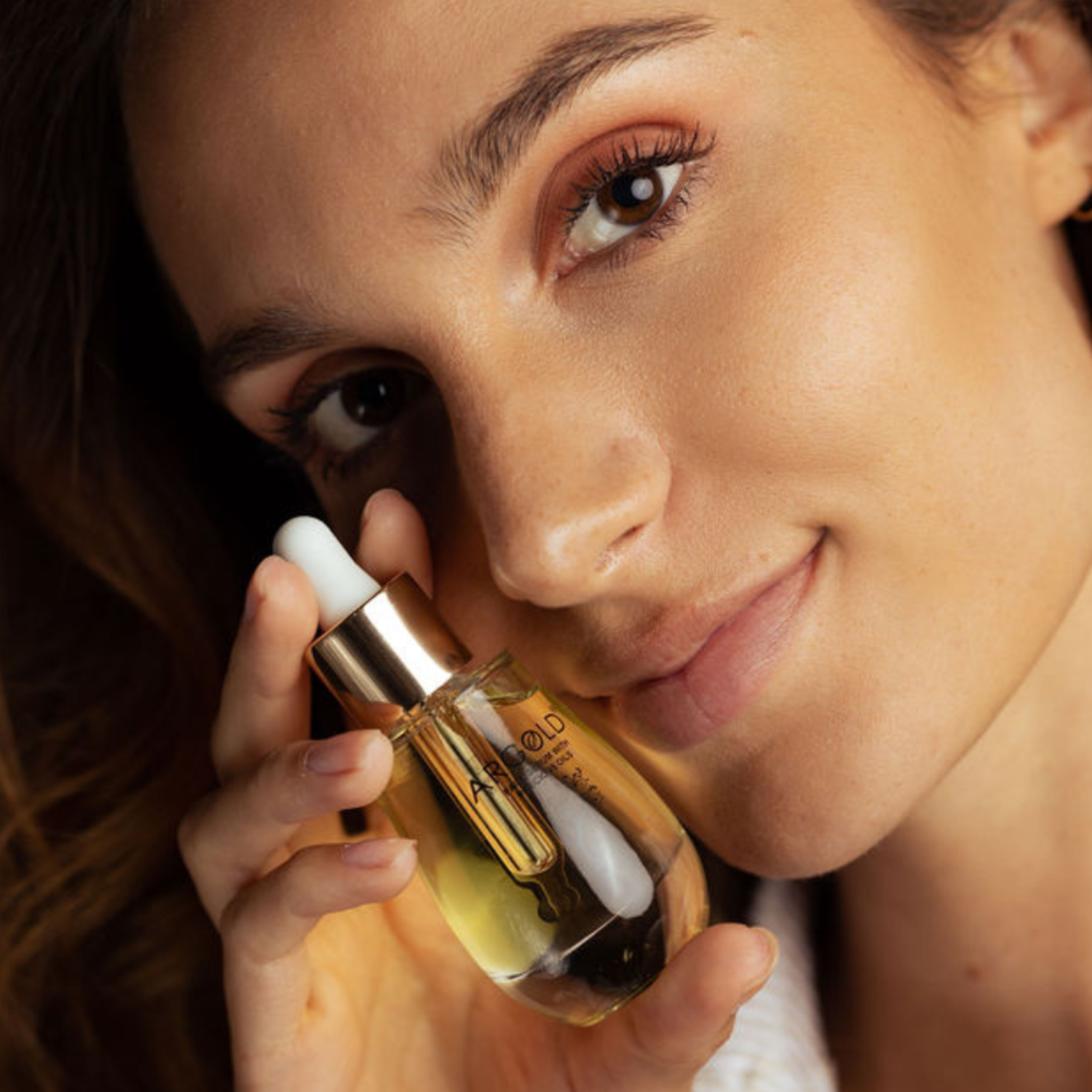
Argan oil is a vegetable oil extracted from the argan tree, a tree native to southwestern Morocco, renowned for nourishing the skin and hair and strengthening their protective barrier. Its richness in fatty acids and vitamin E makes it one of the most versatile natural active ingredients.
Origin and composition
Argan oil is obtained from argan tree kernels. It consists mostly of unsaturated fatty acids, primarily oleic and linoleic acids, and is distinguished by its high content of tocopherols, or vitamin E, an antioxidant, as well as polyphenols and plant sterols [1][2].
Its benefits
Its richness in fatty acids helps strengthen the skin barrier and limit dehydration. Clinically, studies conducted on menopausal women have shown that daily application of argan oil for about two months increased skin elasticity, improved its water content, and reduced transepidermal water loss, indicating a restored barrier [3][4]. Its vitamin E also helps protect the skin from oxidative stress. On the hair, this same lipid richness smooths the cuticle, tames frizz, and restores shine to dry or damaged lengths.
Who it is for and how to use it
Argan oil is particularly suitable for dry skin and dry or curly hair. On the face, apply a few drops in the evening, either alone or as part of a skincare routine. On the hair, it nourishes the lengths and serves as a sealing oil. For more information, see our guides for dry skin and curly hair.
Choosing the right argan oil
Not all argan oils are created equal. For cosmetic use, choose a cold-pressed, virgin, and ideally organic oil, which should not be confused with culinary argan oil, made from roasted kernels and having a stronger aroma. A quality oil absorbs well and does not leave a greasy film. Versatile, it can also be used on brittle nails and dry areas of the body.


Prickly pear: the precious antioxidant
Prickly pear oil, extracted from the seeds of the Opuntia cactus, is one of the natural active ingredients richest in vitamin E and linoleic acid. It is sought after for its antioxidant power and its nourishing effect on dry and mature skin.
Origin and composition
This oil is extracted from the tiny seeds found in the prickly pear fruit. It is one of the vegetable oils richest in linoleic acid and has an exceptional vitamin E content, with a predominance of gamma-tocopherol, a form that is particularly effective at trapping free radicals. It also contains antioxidant phenolic compounds [5][6].
Its benefits
Thanks to its richness in linoleic acid, prickly pear nourishes the skin and supports the reconstruction of the lipid barrier. Its powerful antioxidant properties help protect the skin against oxidative stress, one of the factors in skin aging, and help preserve the skin's suppleness and radiance. It is this dual nourishing and antioxidant action that makes it valuable for skin lacking tone and radiance. Note that we are talking about antioxidant protection and comfort here, not a medical anti-wrinkle effect.
Who it is for and how to use it
It is suitable for dry, mature skin, or skin lacking radiance. A few drops in the evening as part of a nighttime routine are enough. It is often found in serums and facial skincare products. For a complete routine, see our dry skin guide.
Prickly pear or argan oil?
The two complement each other. Prickly pear is even richer in linoleic acid and vitamin E than argan, making it an excellent active ingredient for mature skin and the eye contour, while argan oil remains the versatile standard for skin and hair. Many skincare products combine the two.


Ghassoul: the purifying clay
Ghassoul is a mineral clay from Morocco's Atlas Mountains that purifies the skin and hair by absorbing sebum and impurities without stripping. It is one of the gentlest natural purifiers available.
Origin and composition
Ghassoul, also spelled rhassoul, is a natural clay extracted from the Atlas Mountains in Morocco. It belongs to the smectite family, clays rich in magnesium, and its name comes from an Arabic word meaning to wash [7].
Its benefits
Ghassoul works through two complementary mechanisms: it absorbs excess sebum like a sponge and traps impurities. When rinsed, everything is washed away without friction. Unlike cleanser products made with surfactants, it respects the skin's hydrolipidic film, which remains supple rather than feeling tight, making it suitable even for sensitive skin [8]. Used for centuries in hammams, it remains one of the most versatile natural purifying treatments, for both skin and hair.
Who it is for and how to use it
Ghassoul is suitable for oily, combination skin and skin with imperfections, as well as the scalp. Mix the powder with a little warm water or rose water until you obtain a paste, apply as a mask, leave on without letting it dry completely, then rinse. It is at the heart of the hammam ritual and useful for oily skin.
Ghassoul for hair
Ghassoul is not just for the skin. Applied as a paste to the scalp and lengths, it gently cleanses, absorbs excess sebum without stripping, and leaves hair supple and voluminous. It is a natural alternative to shampoo for spacing out washes. On dry or sensitive skin, add a few drops of vegetable oil to the paste to purify without drying out.


White lily: radiance and purity
White lily is a floral extract traditionally used to brighten the complexion and soothe the skin. It is sought after to restore radiance to dull skin and for its gentle profile.
Origin and properties
White lily, or Lilium candidum, is a flower cultivated since antiquity, whose petals and bulb have long been used in beauty treatments. Its extract is naturally rich in flavonoids, notably kaempferol, as well as saponins and amino acids, compounds that are attributed with soothing properties and a radiance-boosting effect on the complexion [11][12].
Its benefits
White lily is associated with radiance-boosting and soothing actions. Its antioxidant flavonoids limit the cellular oxidation responsible for a grey and dull complexion, and the extract exerts a gentle and natural inhibition of tyrosinase, the enzyme responsible for melanin synthesis, which helps even out the complexion [12]. Its saponins and polysaccharides, meanwhile, form a soothing film appreciated by delicate or redness-prone skin [11]. This is a cosmetic effect of comfort and radiance, clearly distinct from any promise of medical lightening or depigmentation.
Who it is for and how to use it
White lily is for dull complexions and skin seeking softness. It is found in facial skincare products and creams, to be applied as part of your usual routine. It is often combined with other radiance-boosting or hydrating active ingredients in the same formula. As with any plant active ingredient, if your skin is reactive, check that the product containing it does not also contain other irritating ingredients.

Caffeine: fresh eyes
Caffeine is an active ingredient sought after for the eye contour: it helps reduce the appearance of tired eyes, diminish the appearance of puffiness, and revitalize this delicate area. It also has antioxidant properties.
Origin and properties
The caffeine used in cosmetics is a molecule extracted notably from coffee. A small molecule that penetrates the skin well, caffeine acts as an adenosine receptor antagonist: applied locally, it causes a slight tightening of the small blood vessels and stimulates microcirculation, which explains its usefulness for the eye contour [13].
Its benefits
On the eye contour, this mechanism promotes the drainage of accumulated fluids responsible for puffiness, and limits the blood stagnation that colors dark circles, which helps revitalize tired eyes. Applied locally, caffeine also provides antioxidant protection by trapping free radicals linked to UV-induced aging [14]. Its effects are mainly visible on the appearance of fatigue and remain cosmetic. As is often the case in cosmetics, consistency matters: daily use over time gives the best results on this delicate area.
Who it is for and how to use it
Caffeine is ideal for eyes marked by fatigue, puffiness, or dark circles. It is used in an eye contour product, morning and evening, by gently tapping this delicate area. As the eye contour is particularly sensitive, see also our sensitive skin guide.

Hyaluronic acid: deep hydration
Hyaluronic acid is one of the most effective moisturizers available: this molecule, naturally present in the skin, retains water and plumps tissues. It is suitable for all skin types.
Origin and composition
Hyaluronic acid is a natural component of the skin. In cosmetics, it is recognized for its exceptional ability to retain water, up to a thousand times its weight, making it a benchmark humectant [9].
Its benefits
By capturing and retaining water in the superficial layers, hyaluronic acid hydrates, plumps, and smooths dehydration lines without leaving a greasy residue. Its action depends on its molecular weight: at a high molecular weight, it remains on the surface and forms a moisturizing film that softens the skin; at a lower molecular weight, it penetrates further. It is this complementarity that explains its effectiveness. As a result, the skin appears smoother, plumper, and more comfortable, and features marked by fatigue are visibly softened.
Who it is for and how to use it
Hyaluronic acid is suitable for all skin types, including oily and combination skin, as it hydrates without weighing it down. Apply it as a serum to clean skin before your cream. It is particularly useful for combination and sensitive skin.
One thing to know
Hyaluronic acid attracts water, but it does not seal it in. To optimize its action, then apply a cream or oil to limit water evaporation.


Black soap: ancestral exfoliation
Black soap is a paste made from black olives, rich in vitamin E, which prepares the skin for exfoliation by softening dead cells. It is the first step in the hammam ritual.
Origin and composition
Traditional black soap, or beldi soap, is a dark, creamy paste obtained from black olive paste macerated with potash. Made with potash rather than soda, it remains in a soft paste form, and its color comes from olive pigments. It is naturally rich in vitamin E and antioxidants derived from olives [10].
Its benefits
Applied to skin warmed by steam, black soap cleanses, softens, and above all, softens the layer of dead cells on the surface. It is this action that makes the subsequent exfoliation with a kessa mitt much more effective: dead skin then detaches easily. Rich in potassium oleate, it cleanses gently without producing much lather. Combined with the heat of the hammam and exfoliation, it leaves the skin clean, soft, and ready to receive a nourishing treatment.
Who it is for and how to use it
Black soap is used on the body, never on the face, as part of the hammam ritual. On damp, warm skin, leave it on for five to ten minutes, then exfoliate with a kessa mitt. Find the complete ritual in our hammam guide.
Choosing the right black soap
Black soap is available plain or enriched, for example with argan oil for dry skin, or with eucalyptus for its invigorating properties.


Which active for which need
To help you identify them at a glance, here is how to match each active to a skin or hair need. This grid summarizes the sheets above.
| Your skin or your need | Actives to prioritize |
|---|---|
| Dry skin | Argan oil, prickly pear, hyaluronic acid |
| Oily or combination skin | Ghassoul, hyaluronic acid |
| Sensitive skin | Gentle ghassoul, white lily, hyaluronic acid, fragrance-free |
| Dull complexion | White lily, prickly pear |
| Tired eyes | Caffeine, hyaluronic acid |
| Body ritual | Black soap, argan oil |
| Hair | Argan oil, ghassoul |
Remember the principle: start with the need, choose one or two suitable actives, and stick to simple formulas. Dry skin will seek water and lipids, oily skin purification and light hydration, sensitive skin gentleness above all. To learn more according to your case, our guides dedicated to dry skin, oily skin, combination skin, and sensitive skin detail each routine step by step.
How to find them at Argold
True to its Moroccan heritage, Argold places organic argan oil, prickly pear, and Atlas ghassoul at the heart of its treatments, with natural-origin formulas, made in France and Ecocert Cosmos Organic certified. These ingredients—argan and prickly pear to nourish, ghassoul to purify—are featured in the brand's various ranges, from face to hair, as well as the body ritual
Discover Argold treatments: face treatments, hair, body
Natural does not mean risk-free
A natural-origin ingredient is not automatically harmless: a plant can irritate or sensitize as much as a synthetic molecule. Choosing natural does not exempt you from a few precautionary measures.
Read the INCI list, that is, the list of ingredients on the back of the product, to know what it actually contains. Be particularly wary of essential oils and fragrance if your skin is reactive, as they are among the frequent causes of reactions. Perform a tolerance test on a small area before adopting a new treatment, and introduce new products one by one. Finally, in the event of a skin condition or doubt, ask for a dermatologist's advice. To learn everything about reading a label and choosing tolerant treatments, see our sensitive skin guide.
Frequently asked questions about natural actives
Are natural actives less effective than synthetic actives? No. Many natural actives have documented effectiveness, and some, such as hyaluronic acid or plant oils, are benchmarks. Natural is not synonymous with lower performance.
Is a natural ingredient necessarily better tolerated? Not always. Some plants, especially essential oils, are among the most sensitizing. Tolerance depends on the ingredient and the formula, not just its origin.
Does white lily lighten the skin? No. It brings radiance and luminosity to the complexion, which is a cosmetic effect, without depigmenting or lightening the skin tone.
Can you mix several actives in your routine? Yes, by combining complementary functions without excess. On sensitive skin, limit yourself to two or three well-tolerated actives.
How to recognize a quality active? Check the origin and, for oils, cold extraction and organic certification. A short and readable INCI list is often a good sign.
Should you store your treatments in a special way? Natural actives, especially oils and antioxidants, are sensitive to light and heat. Store your treatments away from light, in a cool, dry place, and close the bottles tightly.
Are natural actives suitable for sensitive skin? Yes, provided you choose gentle and well-tolerated actives, such as ghassoul or hyaluronic acid, and avoid fragrance and essential oils. In case of high reactivity, reduce the number of actives and test each new product on a small area.
Scientific sources
- Charrouf Z, Guillaume D. Argan oil and other argan products: Use in dermocosmetology. European Journal of Lipid Science and Technology, 2008.
- El Abbassi A, et al. Argan oil: Occurrence, composition and biomedical applications. Industrial Crops and Products, 2014.
- Boucetta KQ, Charrouf Z, Aguenaou H, Derouiche A, Bensouda Y. The effect of dietary and/or cosmetic argan oil on postmenopausal skin elasticity. Clinical Interventions in Aging, 2015, 10:339-349. PMID 25673976 ; PMCID PMC4321565.
- Boucetta KQ, et al. Skin hydration in postmenopausal women: Argan oil benefit with oral and/or topical use. Menopause Review (Przeglad Menopauzalny), 2014, 13(5):280-288. PMID 26327867.
- Matthäus B, Özcan MM. Habitat effects on yield, fatty acid composition and tocopherol contents of prickly pear (Opuntia ficus-indica L.) seed oils. Food Chemistry, 2011, 125(2):510-514.
- Chougui N, et al. Oil composition and characterisation of phenolic compounds of Opuntia ficus-indica seeds. Food Chemistry, 2013, 139(1-4):796-803.
- Benhammou A, et al. Purification and properties of Moroccan rhassoul clay. Applied Clay Science, 2009, 46(3):317-321.
- Carretero MI. Clay minerals and their beneficial effects upon human health. Applied Clay Science, 2002, 21(3-4):155-163.
- Bukhari SNA, et al. Hyaluronic acid, a promising skin rejuvenating biomedicine. International Journal of Biological Macromolecules, 2018, 110:382-388.
- El Badaoui K, et al. Physicochemical characterization and traditional manufacturing process of Moroccan black soap (Beldi). Journal of Cosmetics, Dermatological Sciences and Applications, 2021.
- Mucaji P, et al. Saponins of Lilium candidum L. and their anti-inflammatory activity. Zeitschrift für Naturforschung C, 2007, 62(9-10):676-682.
- Varani J, et al. Lilium candidum extracts in cosmetics: antioxidant activity and inhibition of melanogenesis in vitro. Journal of Cosmetic Dermatology, 2019, 18(4):1123-1129.
- Herman A, Herman AP. Caffeine's mechanisms of action and its cosmetic use. Skin Pharmacology and Physiology, 2013, 26(1):8-14. PMID 23075568.
- Amnuaikit T, et al. Evaluation of caffeine gels on skin microcirculation and antioxidant activity. International Journal of Cosmetic Science, 2011, 33(6):502-508.